Monday, 6 October 2008

The end


Finally I have come to the end of the route. I have not answered many questions during abseiling, but I have at least brought you some tools for understanding the world. It has been nice blogging in english, which is not my mother tongue. I will not quit blogging. I will just change to a more convenient garment.


Maybe a norwegian sweater, and maybe writing in norsk. With the aid of Bable fish, everything is possible.


Thank you for your kind attention!

Where is the cube?


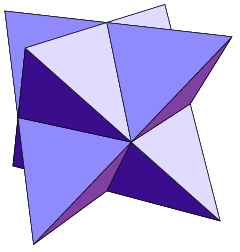
In a former blog I showed a relation between the tetrahedron and the cube. If you try to build it from marbles, you will probably have no success. Rather you get something like this:
Stella Octangula
This is not a cube. The reason it is not, would I explain like this:
If the side of the tetrahedron is a, then the cube is ½*a*sqrt(2), which is an irrational number.
diamond.
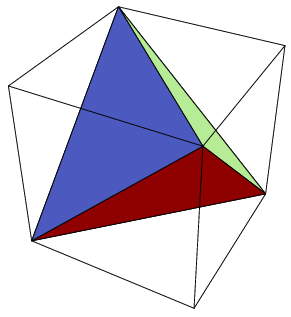
Still there must be a rational relation, since the tetrahedron is called "cubic". The cube looks like this:
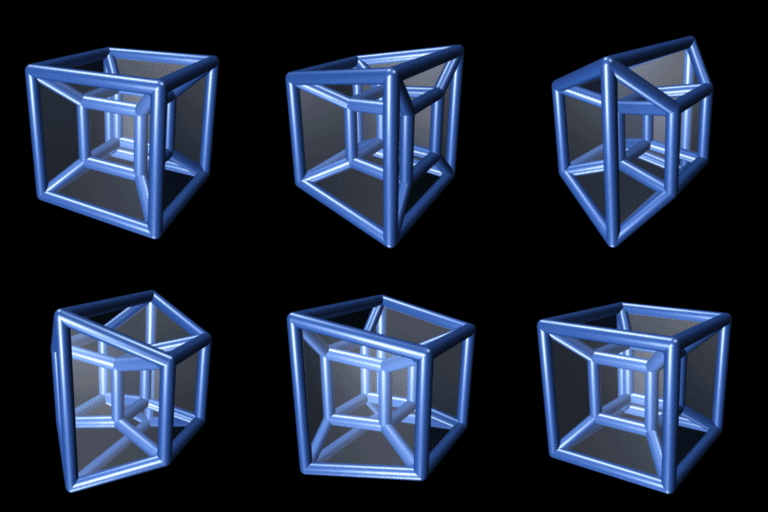
The unit cube. Scary! I should say that this cube is among the last things you discover, when looking at the model. Probably predilection to ortogonal coordinate system brought the term "cubic" to a system that seems to be something else. When you look up "chrystallography", you will most likely get to know, that it is an experimental science. It can also be handled geometrically. The spatial capacity of human mind is often limited, even when concerning professors'. The cure is building models of what you can't imagine. Hand and mind together brings the most out of it. Certainly you know that a coin on the table could be closely surrounded by six equally sized coins. But did you know that a marble in space will have 12, and this can be accomplished in more than one way? Assuming there is a fourth dimension, modelling is not very easy. So this is my problem to you: How many is it in 4D-space? Due to crisis in my economy, I can not give you a prize this time, but I will publish your name and photo.

Dedekind


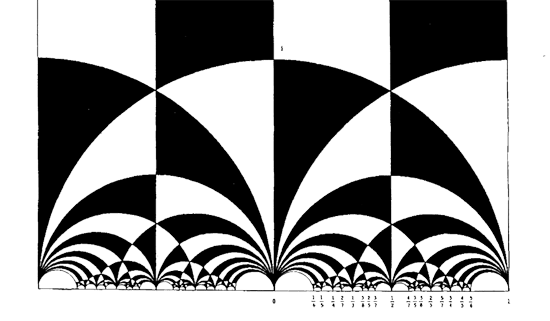
At last I found a definition of real numbers. Richard Dedekind defined them as "cuts" of rational numbers. You will find his text translated to english here: http://www.gutenberg.org/etext/21016

_________________

It is not important, but I was curious after having read many textbooks starting with "definition" of real numbers. Newton did not have the definition. Yet he accomplished a lot. Another thing quite interesting is that there seems to be a definition of "line". Not the straight line, but a kind of curve, that splits the plane in two halves. The text was far too complex for me to understand. I use the term "line" frequently, dispite my lack of knowledge about the definition. Hope I have got it right.

Sunday, 5 October 2008

regular system


Seems like my last actvities brought me too much headache. Maybe I should read a book, for a change.
The cuboctahedron. The "coordination polyhedron" in the fcc. It contains one central point and 12 ligands. The "elementary cubic cell" of the system holds 14 points and has no central point. I find it hard to connect these basic concepts.


_________________

Face centered cubic. Only idiots like me fail to see the cube.

Saturday, 4 October 2008

ccp (continued)

Another imaging of 'close packed cubic', or "face centered cubic", as it is also called, is this:

You start with a layer, that is not closepacked, but rather the conventional rectangular. The second and third layers are dislocated as shown in the picture. It may be hard to see, but each point has 12 neighbours or "ligands". The coordinating polyhedron is a cuboctahedron, which is not "regular". In the simple cubic system each point has 8 ligands, and the octahedron is the coordinating figure. Suppose we are talking about integers! But if we talk about "real" numbers, a paradox will reveal.
I have a cube of points (a;b:c). a b c belongs to the set of real numbers in a certain interval. If I dislocate the layers like said above, and hence changing the structure from simple cubic to face centered cubic, the volume of the cube must decrease. Is there anyone out there who can explain this? The best would be, if you catch me with having made a logical mistake.
_______________
I did a mistake. Hope you see it, too.

A lie is an approximate truth

A segment of a line contains infintely many points. For example the points of the interval [a;a+d] contains alef-null points for any non-vanishing d. Thus: You can't make a line by adding points. Accordingly the plane is not generated by adding lines, and so forth. The point, the line and the plane are sovereign enteties. But the integer correspondances are different. Integer means there are elements. I saw the surrealistic equation on the web:


1+1=3 , for large values of 1


It seems like nonsence, but actually your hand-held calculator may reckon like that. Here is the display (and also its memory):


It uses in fact integers. In this case ten digits for the mantissa and two for the characteristica. What is presented in the display is an interval - not a real number. After the "9" in the mantissa could follow infinitely many digits. These are truncated. When processing long series of calculation, one may get the surrealistic answer. This is only a result of how the machine works - not of mathematics. The Homer Simpson falsification of FLT is an example of false calculation. You can see it is wrong. On the left side there is an odd number and on the right side is an even. How can engineers build things that work, when they are using this false-calculating device? Because "real numbers" are not real. For every-day reckoning ten digits is satisfactory. No one has much use of numbers containing millions of decimals. Math, on the other hand, demands exact calculation. The mathematician wants to know if two enteties are equal, not if they are approximately equal. Hence the "transcendental" numbers. We can stick to the integers 1,2,3.... for a while. Not that I think it will be simple, but it will be "integral".


The sum of 1+2+3... is a "tiangle number"


The sum of triangle numbers 1+3+6... is a "tetrahedral number"


The sum of two consecutive triangle numbers is a "quadratic number" (The quadrate is not elementary in this weird math).


If there is something you can call a "cubic number", I have not found out yet.


__________________


When looking at Wolfram, I gained some self-confidence. This is the first layer in a closed packed system. The second layer must have one point at "X". The third can have a point at eighter A or B. They correspond hexagonal (A) and cubic (B) close packing. Of course, this is seen from one specific angle. There are other angels making it easier to grasp. Building models is the best way to learn.


Friday, 3 October 2008

Tetrahedron


The tetrahedron is
Ta = a*(a+1)*(a+2)/6 ; where 'a' is an integer.

Lemma :
A tetrahedron may be the sum of two tetrahedrons*
Peculiar! A cube is never a sum of two cubes, according to FLT. Seems I don't know the properties of the integers. Do I understand Pythagoras' theorem? Probably not.


This is one relation between the tetrahedron and the cube. There are others, but I have difficulties drawing them. Some other day, maybe.
Today I discovered the OpenOffice programs from Sun. They're free, and contain a lot of facilities. I feel an easy-to-understand proof should be graphical. I do not want to create optical illusions, since I am most serious right now.

_____________________________


* I have a beautiful proof for this lemma, but I don't want to write it right now.

Wednesday, 1 October 2008

October


This month has a latin name, meaning the '8:th month'. Historically the year begun at the vernal equinox. The year in the russian orthodox calender had 365,25 days, which is the reason the 'october revolution' actually happened in november. Of all metrological mess, chronology is the worst. Time keeping differs from culture to culture, and from one country to another. The day begins at noon, midnight, sunrise or sunset, all depending on culture. Adding to that the silly DST the time keeping is most confusing. The "standard pacific time + 1 hr, except for native americans" is the most ridiculous concept. USA likes registering ethnicity. If your grandmother is native american and your grandfather is a jew, then you should not practise 'daylight saving time', but if you're black and your grandmother is hispanic, then you should apply it.